Every April, we recognize Sexual Assault Awareness Month (SAAM), coming together with organizations across the country to educate and engage people about the widespread issue of sexual assault. For RALIANCE, we see this month as an opportunity to recognize and uplift our incredible partners at the local, state, and national level, working with us toward the shared goal of creating equitable, respectful, and safe environments.
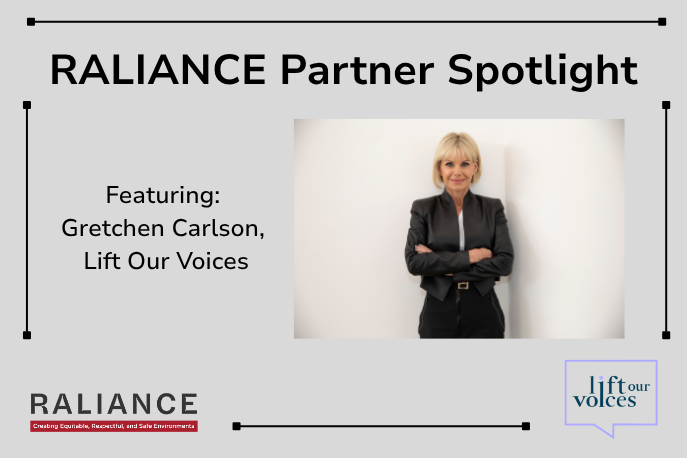
We recently sat down with Lift Our Voices co-founder Gretchen Carlson to discuss the organization’s work to eradicate silencing mechanisms in the workplace and change toxic workplace cultures through legislation, research and educational resources. RALIANCE is proud to have worked with Lift Our Voices to pass the Ending Forced Arbitration of Sexual Assault and Sexual Harassment Act, a groundbreaking piece of legislation which eradicated forced arbitration in cases of sexual misconduct.
To learn more about the organization, our partnership and Gretchen’s story, read our interview with Gretchen below.
RALIANCE: Could you talk about your decision to start Lift Our Voices and the work that the organization has set out to do?
Gretchen Carlson: It’s something I never thought I’d be doing, because it’s not like you wake up one day and go, gee, I hope I’m going to be one of the poster children for sexual harassment in the workplace, but after everything happened to me almost 10 years ago now at Fox News, I determined that I wanted to try and make something good out of a really horrible situation.
Soon after I came forward, I started hearing from thousands of women all around the world and realized that there were two epidemics. There was still the epidemic of sexual misconduct in the workplace, but there was also an epidemic of silencing people who had the courage to come forward. We were giving a false impression to the world that we had overcome all of this but the reason that companies looked like they weren’t having problems with any forms of sexual harassment or discrimination was because it was all going into forced arbitration and [employees] were being slapped with non-disclosure agreements.
I started walking the halls of Congress and got hooked up with the right organizations that had been working on these issues for years. With their knowledge base and my high-profile case, we passed the Ending Forced Arbitration of Sexual Assault and Sexual Harassment Act in March 2022 and the Speak Out Act, which eradicates pre-dispute NDAs for sexual misconduct in the workplace, in December 2022. During that time, I paired up with a woman named Julie Rogsinky, who had also been a contributor at Fox News who filed a lawsuit 10 months after mine, and we formed Lift Our Voices in 2019, which does so much more than just work on legislation. We also do research and education, because people have no earthly idea what they’re signing and typically don’t know what arbitration is, and we’re trying to make people care about this before it’s too late.
RALIANCE: Tell us more about the specific silencing mechanisms that people are facing in the workplace.
Carlson: Most people have no idea what forced arbitration is. The original intent of arbitration was for small business disputes to avoid clogging the court system, but then companies got really smart about 40 years ago, and lawyers especially were like, wow, maybe we could hide all of our dirty laundry in secret arbitration and with non-disclosure agreements, and no one will ever know anything. For frame of reference, in 1991 only 2% of all employees were bound by forced arbitration clauses. This year, 84% of all American workers are bound by forced arbitration and one third of all Americans sign NDAs on their first day of work, thinking it’s only for proprietary information. However, these NDAs have become so expansive that most people have no clue that they’re signing away their right to speak about anything that happens to them from that point forward at work, including bad behavior, pay, assault. These mechanisms are a really great way of keeping these kinds of issues silent, because at Fox News, I had no idea how many people were being affected until I came forward. It’s a way of keeping these issues under wraps, because we all know that if you bring people together that forms power.
We’re the only organization doing this work in the United States, which makes it even more crucial, because we really believe that if you get rid of silencing mechanisms, you finally get to equity. If a company silences you on bad behavior, they’re probably also silencing you on pay equity, promotion, all of that, because it becomes the way that culture works. We believe that by stripping away these silencing mechanisms, companies have to become more transparent about everything, and they can’t hide bad actors. That’s the whole point of all this.
RALIANCE: How has the experience of founding Lift Our Voices and career pivoting completely impacted you from a personal standpoint?
Carlson: My life has worked in really mysterious ways. I’ve had to pivot a lot, and I hope I can be an example to other people, especially women, that no matter what your age is, you can always find purpose. I grew up in a small town in Minnesota and was a serious concert violinist as a child, but then I burned out when I was 17 and went to Stanford to focus on my education. Then, my mom wanted me to play the violin again. She heard about the Miss America competition, where half your points were based on talent, and convinced me to enter. After becoming Miss America and being in the public eye, I got into TV instead of being a lawyer and was in the industry for 25 years before coming forward at Fox News.
It’s been a lot of twists and turns, but the one constant in my life has been incredible hard work and perseverance and absolutely never, ever giving up. I found myself in this situation 10 years ago when they fired me and I thought I was just going to be sitting in my house crying my eyes out every single day. Instead, I found this massive purpose, and I have absolutely no regrets, because I think that this will actually end up being what’s on my headstone when I die: she never owned her own voice. By the way, I still don’t own my own voice and I’m still bound to an incredibly stringent NDA. There’s been movies made about my story and mini series that I can comment on, but I can’t tell you if they’re accurate portrayals, my family can’t tell you. My goal has been, if I’m not going to own my own voice, I’m going to ensure that millions of other people do. I hope my journey is inspirational to other people who are struggling and shows there can be good at the end. I feel so satisfied with this work, knowing that I’m helping people, and it’s just something I never expected to do.
RALIANCE: What advice do you have for any companies or organizations who are looking to be part of the solution against this issue?
Carlson: We extend the olive branch to all companies. It has become the way of the world, unfortunately, to silence employees, but let us educate you so you can come to the right side of history. More and more people are becoming educated on these issues. We are relentless, and the more they become educated, the more upset they’re going to be when they find out they’re being silenced and they’re not going to want to work there, especially young people. My generation tried to follow the rules, and nobody spoke up because we just wanted to continue to have a job. It’s different now, and I encourage companies to take a hard look at how they’re treating their employees. Really, the power sits at the top. I always say the CEO can change it in a snap. Imagine if you came into a company and the CEO said, “I’m not going to silence people. I know bad stuff is probably going to happen, but we’re going to own it, and instead of silencing people and getting rid of the people who have the courage to come forward, we’re going to do an independent investigation and get rid of the bad actor.” Instead, companies spend millions and millions of dollars on insurance policies for their C-suite executives in case something bad happens. The first instinct is how do we get rid of that person who had the courage to come forward. So, it sounds so simple when I explain it like that, but that’s not what’s happening. I encourage companies to join our mission, learn more about it, and we’re here to help them on that road to more transparency.
RALIANCE: How does Lift Our Voices partner with other organizations in the space?
Gretchen: First of all, RALIANCE has been an amazing partner. If it wasn’t for RALIANCE, none of our legislation would have ever passed. Terri Poore specifically was so involved in this and was able to mobilize people, as well as the survivors who testified before Congress. So really, this achievement is on the shoulders of organizations like RALIANCE and the survivors who were able to share their stories.
We also work with organizations that work to lift up people who are most affected by silencing mechanisms. I’ll give you an example. The highest rate of people who are silenced in our society, at 65%, are minimum wage workers, who are probably also people of color. The more disenfranchised you are in society, the more likely something bad happens to you at work. You’re silenced. So, we’re hoping to work soon with the National Domestic Workers Alliance, because think about all the domestic workers that fit into that category and the National Urban League, because the next bracket of people who are silenced at a high rate are African American women, and then African American men. Then we’ll work with an organization called Maremoto, which reaches 1/3 of the Latino workforce. I also want to point out that around 50% of all white people, including white men, are silenced. This is a phenomenon that affects everyone, but it affects certain groups at higher percentages in a backwards way.
RALIANCE: As you look forward, where do you see Lift Our Voices and your work going in the future?
Gretchen: We have another bipartisan bill right now called the Protecting Older Americans Act, which would get rid of age discrimination with forced arbitration. I’ll be completely honest, the political environment right now on the Hill is difficult, but we continue to work behind the scenes to move this bill along and build our coalitions, because if the political landscape changes, we will be able to try to push it through. The strategy is to take on one protected class at a time and really make our marks until we finally get to the end where we have everyone included.
We’re embarking right now on an important research study on the mental health of being silenced. It’s hard to study, because people can’t tell you when they have NDAs, right? But imagine what this study is going to find – probably, like we all know, being silenced is not good for your psyche. We’re really looking forward to this study, sort of a first of its kind, about what we have done to our society by silencing so many people about bad things that have happened to them. That will come out this fall.
We are also in the process of building out a student certificate program, which will teach first time job seekers about forced arbitration and NDAs so that they will start to ask these questions of their workplace. Right now, the way it works for people is, if you ask questions, they’re probably going to go on to the next person. If we can start educating more people to get together in groups, then we can start to change the culture. Changing culture seems almost impossible, because it’s so ingrained in us from young ages in how we’re socialized. This is decades of work ahead and I always say solving this is a tangled web. We have to educate, we have to do research, we have to get to our people young. We have to get first time job seekers to start asking questions.
Thank you to Gretchen Carlson for her time. To learn more, please go to liftourvoices.org.
RALIANCE is a trusted adviser for organizations committed to building cultures that are safe, equitable, and respectful. RALIANCE offers unparalleled expertise in serving survivors of sexual harassment, misconduct, and abuse which drives our mission to help organizations across sectors create inclusive environments for all. For more information, please visit www.RALIANCE.org.